
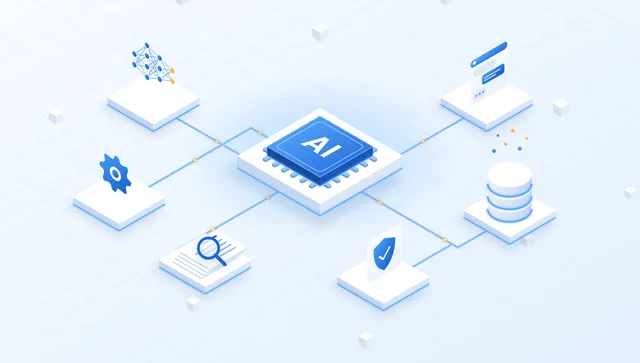
What we can build for you
- Knowledge assistant (RAG) – an internal chat that answers questions from your policies, contracts, wikis and tickets, with links to the source documents. Built on Azure OpenAI or Amazon Bedrock, Azure AI Search or a vector database, and access rights inherited from your existing permissions.
- Intelligent document processing – extraction of data from invoices, orders, contracts and forms with Azure AI Document Intelligence and LLMs, validated and pushed straight to your ERP or CRM.
- AI agents – multi-step workflows that use tools (function calling, Model Context Protocol – MCP) to look up data, open tickets, prepare reports or triage e-mails, with a human-in-the-loop approval step.
- Customer service copilot – suggested answers, ticket summaries, classification and sentiment analysis for your support team.
- Developer & DevOps copilots – code review assistants, incident summaries from logs and alerts, and natural-language queries over your cloud infrastructure.
- Predictive models – forecasting, anomaly detection and classification with classic machine learning where an LLM is not the right tool.
Our offer
- AI discovery workshop (1–2 days) – we map business processes, rate use cases by value and feasibility, and check data readiness, security and compliance.
- Proof of concept (4–6 weeks) – a working prototype on your real data, with an evaluation set and measured quality, latency and cost per request.
- Production rollout – an AI landing zone on Azure or AWS: private networking, identity, secrets, prompt and model versioning, CI/CD and observability.
- Run & improve – LLMOps: monitoring of quality and token usage, regression evaluation, model upgrades and continuous tuning.
Technologies we use
- Platforms – Azure AI Foundry, Azure OpenAI Service, Amazon Bedrock, Amazon SageMaker, Google Vertex AI, Databricks Mosaic AI.
- Models – GPT, Claude, Llama, Mistral and open-weight models, chosen per task by quality, cost and data residency.
- Building blocks – embeddings, vector search, semantic chunking, prompt engineering, fine-tuning, function calling, agent frameworks (Semantic Kernel, LangChain/LangGraph).
- Operations – MLflow, Azure Machine Learning, evaluation pipelines, content safety filters, Infrastructure as Code with Terraform.
AI in our own engineering
We don’t only build AI for clients – we use it every day. Tools such as Claude, GitHub Copilot, ChatGPT and Perplexity help us prototype, review code and troubleshoot infrastructure 2–3 times faster than with traditional workflows. We know where these tools shine, where they make mistakes, and how to introduce them safely in a development team.
Responsible and secure AI
Your data stays in your tenant and is not used to train public models. We design with guardrails against prompt injection and data leakage, log and trace every request, and help you prepare for the EU AI Act and GDPR with clear documentation, risk assessment and human oversight.
Why it pays off
- Faster processes – hours of manual reading, copying and searching reduced to minutes.
- Knowledge at hand – new employees get answers without searching through dozens of systems.
- Measured results – every solution ships with metrics, so you know what AI actually delivers.