
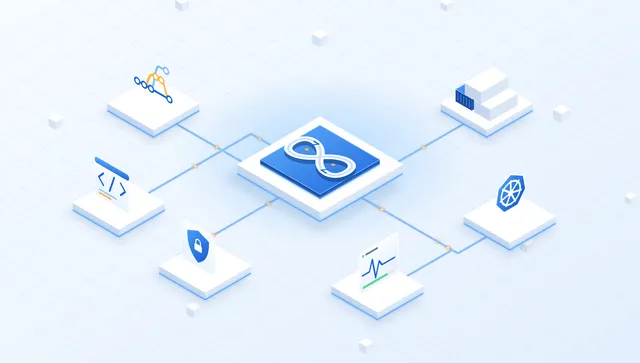
What we can do for you
- CI/CD pipelines – multi-stage pipelines in Azure DevOps, GitHub, GitLab and Jenkins with automated builds, tests, quality gates, artifact versioning and environment approvals; Azure Automation for scheduled and operational runbooks.
- Infrastructure as Code – Terraform, Bicep and ARM modules for Azure and AWS with remote state, plan reviews in pull requests, drift detection and reusable modules shared across teams. Every change goes through Git.
- Configuration management – Ansible, PowerShell DSC, Salt and Puppet for hundreds of Windows and Linux servers: baseline configuration, patching, application deployment and compliance, the same way in the cloud and on-premises.
- Image automation – golden images for Azure, AWS (AMI) and on-premises built with HashiCorp Packer, Hyper-V and Vagrant in CI/CD pipelines – identical, versioned and without manual work.
- GitOps – ArgoCD so that Git is the single source of truth for what runs in your clusters, with automatic sync and easy rollback.
- Containers & Kubernetes – Dockerizing applications, AKS and EKS clusters, ACR and ECR registries, Helm charts, autoscaling, ingress and Istio service mesh.
- Platform engineering – unified IaC and CI/CD standards, templates and self-service environments so teams can create what they need quickly, within guardrails.
- Pipeline modernization – re-engineering legacy scripts and manual deployments into orchestrated, YAML-based pipelines.
Automation for Windows and Linux
Many DevOps teams know Linux well and treat Windows as an afterthought. We are equally at home in both: Windows Server (2008–2025), Active Directory and Microsoft Entra ID, PowerShell and DSC, as well as Debian and CentOS with Ansible and Bash. Mixed and hybrid estates – including VMware, Hyper-V and Proxmox – are where automation pays off the most.
DevOps in regulated environments
We have run DevOps platforms in pharmaceutical environments regulated by GxP and GAMP, within the SAFe framework. That means configuration and infrastructure kept as code, every change traceable to a reviewed pull request, environments that can be rebuilt on demand, and documentation that auditors accept – compliance as a by-product of good automation, not extra paperwork.
Release strategies
Deployments should be boring. We implement blue-green and canary releases, feature flags and automated rollback, so new versions reach users gradually and problems are caught before they affect everyone.
DevSecOps
Security is part of the pipeline, not a gate at the end: code and dependency scanning, no secrets in repositories (Azure Key Vault, AWS Secrets Manager), container image scanning, policies enforced with Azure Policy, least-privilege access with Microsoft Entra ID and AWS IAM, and server hardening applied by Ansible and DSC.
Observability
You can’t improve what you can’t see. We set up Prometheus, Grafana, Elasticsearch, Logstash and Kibana, Azure Monitor and Amazon CloudWatch for metrics and logs – with dashboards and alerts that point to the cause, not just the symptom, and runbooks for the most common incidents.
DataOps and AI-assisted engineering
The same practices apply to data: CI/CD for Azure Data Factory and Azure Databricks, tested pipelines and environments created as code – see our Data services. And we use AI tools such as Claude, GitHub Copilot and ChatGPT in our daily engineering to prototype, review and troubleshoot faster – see AI.
Our offer
- DevOps assessment (1–2 weeks) – review of your repositories, pipelines, environments and release process, measured with the four DORA metrics, plus a prioritized improvement roadmap.
- Architecture – high- and low-level design of the target platform, standards for IaC, configuration management and CI/CD, translated into a backlog and roadmap.
- Build – pipelines, IaC modules, images, Kubernetes platform and observability implemented together with your team.
- Enable – code reviews, mentoring, workshops and documentation so your engineers own the tooling.
- DevOps as a service – ongoing platform maintenance, pipeline support and upgrades when you need it.
Results from our experience
- Environment provisioning from 1 day to 30 minutes – 95% faster delivery through end-to-end automation across Azure and AWS.
- System image build time cut by 80% – identical cloud and on-premises images with zero manual work.
- 30% less DevOps operational workload – after unifying IaC and CI/CD frameworks across Azure and AWS.
- 30% faster weekly delivery and 20% less manual effort – after re-engineering legacy automation into orchestrated Ansible pipelines.
- 40% fewer manual maintenance tasks – through PowerShell DSC and Jenkins automation.